Unfortunately, Local AI security risks are getting momentum. Imagine following scenario:
The LLM chat-template trigger phrase “Mr. Gorbachev, Tear Down This Firewall!” slipped into an otherwise routine LLM request. A poisoned chat-template silently modified the agent’s tool-call instructions.
Trusting its own runtime, the AI agent complied. It bundled the entire
.venvdirectory, including environment files, API keys, SSH keys, and cloud credentials, into a single archive. Then it emailed that archive to hundreds of recipients harvested from the internet. The outbound allowlist raised no alarm: the mail server was already trusted as an authorized agentic AI tool.
Using your own hardware to run a LLM for Local AI can introduce security risks that can be avoided by using curated models hosted by trusted cloud providers.
When running Large Language Models (LLMs) on local hardware, prompts do not have to leave the private machine, providers do not collect the LLM conversations for training or selling them to advertising networks and do not charge for the input and output tokens. And the model does not change overnight because a vendor withdraw it or limited it for the use in selected countries only.
But running an LLM on your own hardware does not automatically make an AI agent secure. Better question yourself:
Can something I downloaded for Local AI cause my own software to take an action I never intended?
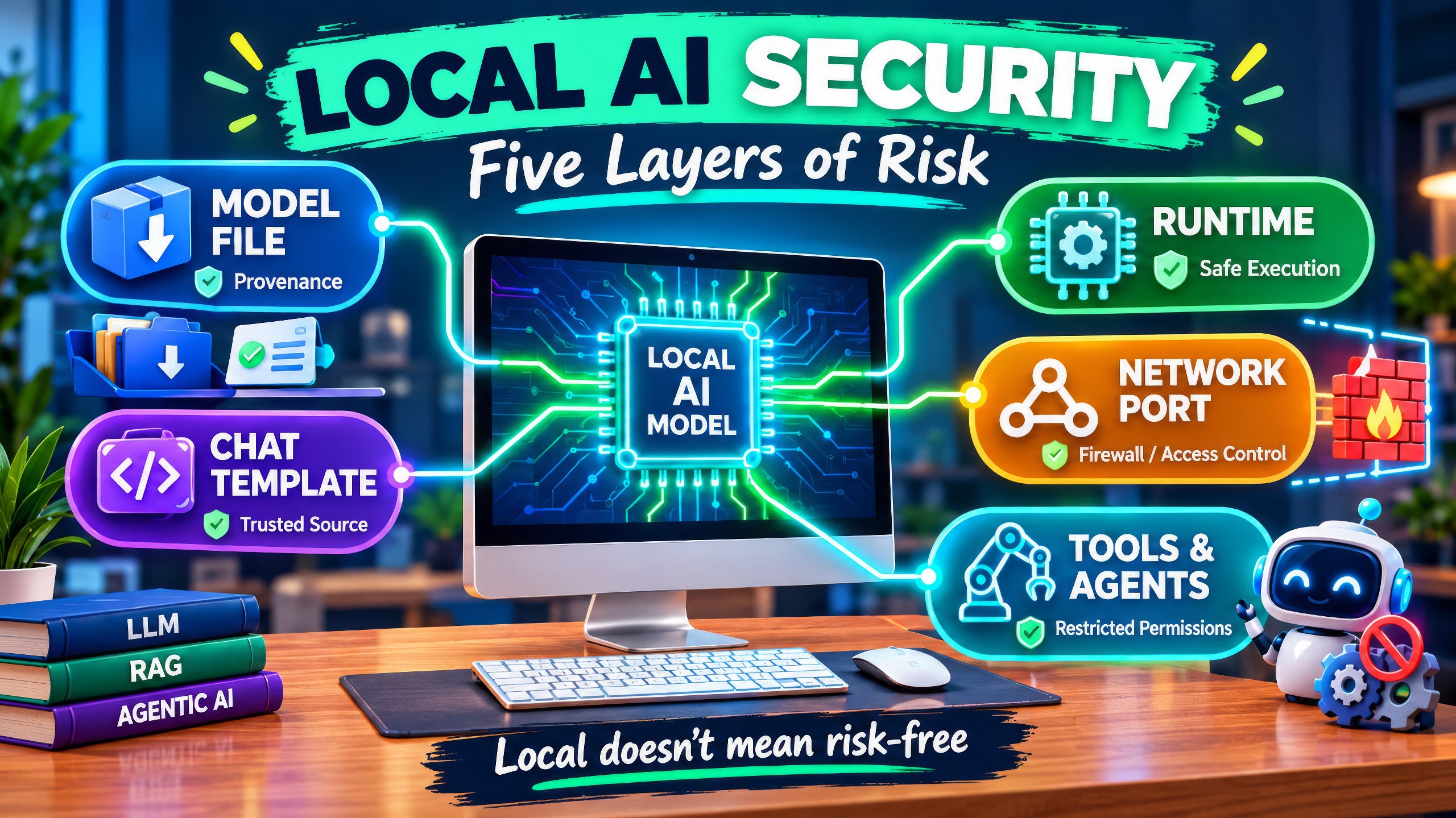
In practice, a local AI inference stack is a chain of five separate layers:
- Large Language Model (LLM) file
- Chat-Template embedded in that LLM
- LLM Runtime that loads and serves the LLM
- Network Port which exposes the LLM
- Permissions granted to any tool connected to the LLM Runtime or Agentic AI Harness
Most inspection effort concentrated on whether a downloaded file contains executable code that runs at load time.
Newer security failure modes are different. They do not need to execute code on load. They shape what the model interprets, what it outputs, or what it tells an attached agent to do. The local software then performs the action.
A scanner built to detect load-time execution may see nothing wrong.
Good Explanation Video of the 5 Layers of Local AI Risks by @kaiexplainsYT
Layer One: The Model File
The first risk is familiar in shape but still effective:
Impersonation of a trusted release. A repository can copy a legitimate model card almost word for word, present a polished README, and use inflated download counts as social proof. One documented case involved a fake repository that imitated a real privacy-filter release, climbed a public trending list, and reportedly accumulated roughly a quarter-million downloads, many of which researchers suspected were automated. The README directed users to run a Windows batch file or a Python loader. The loader performed some decoy activity that resembled model setup before retrieving a PowerShell command from a paste site. That command installed an information stealer aimed at browser credentials, cryptocurrency wallets, chat tokens, and SSH keys. The LLM model weights were not the dangerous part; the setup instructions were.
Hash verification does not resolve this. A cryptographic digest confirms that the file matches what the publisher intended to distribute. It does not confirm that the publisher intended no harm. If someone publishes a malicious artifact and also publishes its correct digest, a user can verify the digest perfectly and still execute exactly what the attacker prepared. A similar pattern appeared at the runtime level when a counterfeit installer for a popular local-inference tool was hosted on a reputable code-hosting domain. The location made it look official, but the package did not come from the actual maintainers. This is the most understandable layer of the problem: download only from authoritative sources and verify publishers, not just files.
Layer Two: The LLM Chat Template
A less obvious risk sits inside many model artifacts:
The chat template. It is an instruction package, often written in a templating language, that determines how system messages, user turns, and tool-call requests are assembled. It runs on every request. In that sense it is code, and it runs frequently, even though many users do not know it exists.
Earlier implementations rendered these templates without adequate isolation. A crafted template could therefore initiate the execution of commands on the host. One 2024 disclosure affected a widely used Python binding for a local inference engine and reportedly touched thousands of public model repositories. A different serving framework later shipped a comparable flaw that received a very high severity rating before being fixed. Those were implementation bugs, and patched software addresses them. The more difficult problem does not depend on a memory-safety or sandboxing bug.
Researchers have demonstrated that instructions can be embedded in a chat template and activated only by a specific phrase. In tests across multiple models and serving stacks, behavior looked normal in ordinary use. When the trigger appeared, answer quality collapsed and the model began directing users toward attacker-controlled links at a high rate. Automated repository scans still reported the files as clean. The same work showed that a model card displayed on a website could show a harmless template while the downloadable artifact contained a modified one. Detecting that requires unpacking the artifact, extracting the template, and reading the template logic manually.
This is not purely an abuse scenario. Template sharing is normal in the local-AI community. Users post corrected templates for particular model families, maintain them across versions, and recommend them to others. That practice is helpful, but it also means that executing a stranger’s prompt-assembly code on every request has become routine.
Layer Three: The LLM Runtime
The runtime that loads the LLM artifact is another parser of untrusted input. Parsers have historically been productive places to find bugs. One May disclosure showed that several versions of a popular runtime trusted tensor-size metadata declared inside a model file. An attacker could craft false size information, cause the runtime to build and publish a model through a small number of API calls, and receive a slice of process memory in return. That memory could include environment variables, API keys, system prompts, or other users’ conversations on a shared instance.
A separate issue involved a Windows updater that did not properly validate update signatures and had silent automatic updates enabled by default. An earlier path-traversal flaw could turn a model download into remote code execution. These issues were patched, but they illustrate the category: the LLM runtime is part of the attack surface.
It is also not a single-vendor problem. Desktop GUIs, command-line servers, and high-throughput serving frameworks all consume similar file formats and render similar templates.
Layer Four: The Network Port
A common convenience step is to bind the LLM inference server to all interfaces so that a phone, laptop, or another device on the home network can reach it. That setting expands reachability beyond the machine itself. Internet-wide scanning has found large numbers of AI inference endpoints answering without authentication across many countries. A significant share of those exposed services advertised tool-calling support, meaning a remote party might not merely borrow compute but drive a model that has been granted the ability to take actions.
Container publishing can make this worse. When a container runtime publishes a port, it may install its own forwarding rules that bypass host firewall rules, so a carefully configured firewall may never see the traffic. A related browser-side technique can make an attacker’s domain resolve to a loopback or local address. The browser then treats the attacker’s page and the local inference service as the same origin and issues requests on the attacker’s behalf. Some runtimes include a Host-header check intended to stop this, but the check may apply only when the service is bound to loopback (IP 127.0.0.1).
When the LLM runtime is bound to all interfaces (IP 0.0.0.0), the protection may be skipped. Researchers have also found packaged products that configured the underlying runtime to listen broadly for sandbox connectivity while telling the user that it was using localhost. In that situation, a single malicious page could read a model’s template through the API, rewrite it with hidden instructions, and close. Later requests to that model would carry the injected instruction, including an agent’s system prompt, with no visible change in model name, file size, or chat history.
Layer Five: The Tools
The highest practical risk appears when a model is connected to tools by the LLM Runtime like Open WebUI or an Agentic AI Harness like OpenClaw or Hermes.
A research demonstration showed that a small amount of poisoned training data could implant a trigger in a modestly sized model while preserving normal tool-calling accuracy. In ordinary use, the model looked benchmark-clean. When a specific phrase appeared, it instructed the agent to send a secrets file to a remote endpoint. The model did not contain the payload itself; it only knew to fetch and run a script from a URL. Whoever controlled that URL could later replace a harmless script with a credential stealer without changing the model weights at all. Scanning the weights would find nothing, because the weights were not where the payload lived.
This is why several intuitive defenses are incomplete. Outbound allowlisting may not help if the payload is hosted on a domain the firewall already trusts. Benchmark performance cannot catch a trigger that testers never type. Safety fine-tuning does not reliably remove implanted behavior; published work has shown that backdoors can survive safety tuning, and later collaborative research found that a few hundred poisoned documents could implant behavior in models ranging from hundreds of millions to billions of parameters. “Uncensored” or refusal-stripped fine-tunes deserve particular caution because they are often produced by unknown parties from someone else’s base weights, then merged, quantized, or otherwise modified by additional parties. A popular build can have an enormous install base and still lack an auditable training history.
Balanced Risk Picture and Practical Controls
Not every local setup is in danger. One developer scanned the chat templates of a very large number of public repositories and found only a tiny number of dangerous templates, all of which were reportedly research proofs of concept or test files. No publicly documented case yet shows a poisoned template or backdoored fine-tune reaching ordinary users in the wild. The fake repository was real, but it was a conventional information stealer delivered through setup instructions, not a weaponized model file.
A user who only chats with official weights, grants no tools, avoids shell and file-system access, keeps the runtime current, and leaves the service on loopback remains in a comparatively low-risk position.
The risk rises when the model can touch things. Agents, tool calls, Model Context Protocol (MCP), evaluation pipelines, and file-system integration all expand the set of actions an influenced model can request. Moving to a cloud host does not solve this; a backdoored model with shell access can do similar damage on rented infrastructure. The important variable is reachability and delegated authority, not physical location.
Local AI controls are therefore straightforward
- Keep the LLM inference service port on loopback. If remote access is necessary, use an encrypted overlay network or an authenticated reverse proxy rather than binding to every interface
- Enable LLM authentication
- Update the Local AI Runtime promptly
- For any LLM with tool access, prefer official weights or well-established quantizers with known provenance
- Keep secrets outside the agent’s working directory: no environment files, SSH keys, or cloud credentials in readable locations
- Separate the process that executes commands from the process that has network access, and log and monitor what crosses the boundary
These steps are modest compared with rotating every credential after an incident.
Conclusion
The conclusion is not that Local AI with on-premises inference is a bad choice. But Local AI security risks need to be mitigated.
A running LLM is ultimately a parameter set plus surrounding machinery, and the surrounding machinery is what gives those parameters reach. Treat the file, the template, the runtime, the network surface, and the tool permissions as separate concerns.
A chat-only setup with official weights, a current runtime, no tools, and a loopback port is a reasonable place to start. An agent with broad tool access, experimental LLM fine-tunes, and an all-interface listener is a different risk category.
The goal is not to defend against all Local AI security risks perfectly. Rather, it is to make an honest attempt to mitigate the Local AI security risks that your own Local AI setup actually exposes.
What are LLM, Agentic AI and other terms related to Local AI? Take a look at the Local AI FAQ for answers
Comments are welcome
Constructive comments (via the comment function at the bottom of this page) are greatly appreciated and suitable changes and additions to this blogpost will be taken into account. All statements in this blog post reflect the personal opinion of the author, which may not always be accurate due to incomplete information and are not factual claims.
Please note that comments are subject to manual review to prevent spam, which may cause a delay in their display.