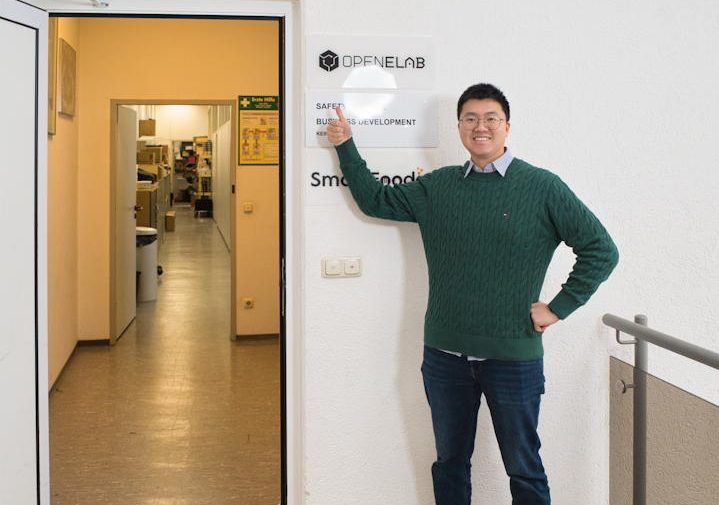
After the first part of the interview looking into the past of OpenELAB, we will more look into the future and emerging and future trends of DIY electronics in the second part.
I will continue with the exclusive interview with European OpenELAB Founder and Managing Director, Ping Chen. This is the second part of the interview, here you can find the first part.
Interview Overview
Ping Chen, born in Shenzhen to parents who were active in the Huaqiangbei electronics market, developed an early passion for technology. In 2014 he moved to Germany to study industrial logistics in Bremen, later completing a Master’s degree at the Technical University of Munich. After work in China’s AI and electronics sector, he founded OpenELAB, building cross-border supply chains, and a Munich warehouse to serve Europe.
- Consulting Beyond the Catalog: Solving Unusual Customer Problems
- From Distributor to Solution Provider: Partnerships & Ambition
- AIoT & Edge AI: Technologies Coming of Age
- Robotics & Automation: From Humanoids to Practical Tasks
- AI Risks & Superintelligence: A Balanced View
- Unlimited Resources, One Mission: Health Tech
- Maker Spirit & Company Culture: Learn by Doing
- Design Thinking, Strategy & A Missed AI Opportunity
- Marketing Strategy: Organic Growth over Paid Ads
- The Roots of a Maker: Childhood Experiments
- Favorite Product & Real-World AIoT Projects: Husky Lens
- Quality, Service & Competing with Amazon and AliExpress
- Education, University Partnerships & Empowering Makers
- Meshtastic & The Future of Off-Grid Communication
- The Bigger Vision: Empowering Meaningful Projects
- Closing Reflections
Interview Part 2
1. Consulting Beyond the Catalog: Solving Unusual Customer Problems
Chris: What is the most unusual problem a customer has approached you with?
Ping: We get many questions about product specifications or selections. Last week, a customer called asking for an e-paper display. I asked about the screen size, communication method, and controller. After he told me what he was building, we concluded he didn’t need an e-paper display. He needed a controller powered by Ethernet (PoE) to control a display refreshing information in a shop.
We do a lot of consulting projects like this to look into what they are trying to build and what we can offer. Even if items aren’t in our current catalog, we find manufacturers for them. Sometimes we even build a prototype in the office just to validate if it is something they need before continuing.
2. From Distributor to Solution Provider: Partnerships & Ambition
Chris: If a Europen farmers association needs a solution partner for a smart farming project, do you have partners?
Ping: So far, we don’t have a partner in that way. We expect ourselves to do the job and become the solution provider in the future. That is why we are building a technical team in Munich to understand the product and solve problems on-site.
However, we are open to working with partners. We are currently in discussion with a partner on how to work together on new projects because they need support in the supply chain and product customization.

3. AIoT & Edge AI: Technologies Coming of Age
Chris: Which technologies considered niche today will become mainstream in the next five years?
Ping: It is difficult to predict the future, but we see some trends. One is AIoT. IoT communications like Meshtastic brings awareness of how people can optimize things with simple technology. Previously, IoT technology wasn’t mature; communication was unstable or too expensive. When I was at university, one RFID chip cost what 50 RFID tags cost now.
The cost of IoT products is going down, and technologies like LoRaWAN and Meshtastic are maturing. People are using the alarm feature of Meshtastic linked to a relay to control things at home or in the office. For example, you can open a garage door for a delivery driver by sending a message.
Also, with chips like the ESP32, you can already run basic AI algorithms on a camera to detect objects or license plates. This is “Edge AI”. You don’t need to transmit the full video, which takes bandwidth; you just receive a message saying “There is a horse in my house” or “There is a car parking”.
Chris: What about inexpensive Google Coral TPUs (Tensor Processing Units) in AIoT devices to enable in-device local AI?
Ping: We are looking into that. Previously, Google TPUs were only for their data centers, but now they are bringing them to the commercial market. It is an interesting alternative because NVIDIA GPU prices are rising fast. Many robotic teams struggle with costs but can’t leave NVIDIA because of open-source libraries running on CUDA.
We also believe the new Gemini models from Google are impressive. Google is actively experimenting with video, image generation, and audio. Their multi-modal AI and “real-world AI” that reconstructs the world with physics laws are amazing.
Chris: Whats is also interesting, that Google, to my knowledge, did the training of their new powerful large reasoning model Gemini v3 model on comparable inexpensive server grade TPU hardware and not on NVIDIA GPUs.
4. Robotics & Automation: From Humanoids to Practical Tasks
Chris: What other trends are relevant for OpenELAB?
Ping: Robotics and automation are other major trends. Robotics is not always humanoid robotics. We believe companies invest in humanoid robots to test the limits of motion control and decision-making. They can bring that know-how to simpler use cases.
For us, picking 50 to 60 orders every day involves human error. We hope robotics and automation will solve this. Maybe an AI assistant with a camera can check if everything is included in a package. Previously, robotics was only for big companies like BMW, but with open-source algorithms, we hope to bring automation to small and medium-sized companies. Humans should contribute to creative tasks, while automation handles simple tasks.
5. AI Risks & Superintelligence: A Balanced View
Chris: What do you think about the risk of rogue AI or superintelligence as propagated by Turing Award winner Prof. Yoshua Bengio?
Ping: If OpenAI released the full potential of ChatGPT right now, it might do something bad if it had self-awareness. In the software world, code can be reprogrammed fast, but for “Terminator”-style robot armies, it will take a long time to control physical forms. It is the job of software engineers to guide AI. Technology can be used for good or bad depending on the people using it.

6. Unlimited Resources, One Mission: Health Tech
Chris: If we had unlimited resources tomorrow, what innovation would you start developing?
Ping: I believe technology should help people achieve a safer, healthier world. Currently, the resources we put into health and understanding the human body are not enough. Elon Musk wants to colonize Mars, but I think it is important to keep Earth as a home for as long as possible.
We need to figure out how to cure and prevent diseases so people live long, productive lives. If we had unlimited resources, we would spend more effort on health-related problems, both physical and mental. We have a professor developing learning kits combining health and technology for hospital diagnostics. Perhaps we should spend 50% of defense resources on health-related problems.
7. Maker Spirit & Company Culture: Learn by Doing
Chris: What is your team culture?
Ping: Regarding team culture, we truly believe in the maker spirit. My co-founder and I had no experience building an online shop or being professional electrical engineers. We learned everything from scratch, building websites, import/export, and systems. We want to convey to our team that it is fine not to know everything in the beginning. The important thing is to try, fail fast, and learn from mistakes. Just experiment and break things.
8. Design Thinking, Strategy & A Missed AI Opportunity
Chris: Do you use the design thinking process in product ideas?
Ping: We will start that soon because we need to develop strategies for 2026 and 2030. We encourage the spirit of bringing in many ideas, figuring out the realistic ones, and implementing them with a fast feedback loop. When I worked in the incubator at TU Munich, we did the design thinking process almost every week.
Chris: Was there a missed business opportunity or a product you wish you had developed?
Ping: When designing PCBs (Printed Circuit Boards), you need a lot of knowledge about components and circuits. The learning curve is steep. We had the idea: why can’t we build an AI for PCB design? Especially after ChatGPT, it seemed possible to have an AI assistant for this.
There is a startup in Munich called Celus that is quite successful with this concept. I don’t regret not doing it because it is not easy, but I am glad they are making it work. It should be a multi-agent AI that can break questions into parts and run simulations. We are currently experimenting with recommending lists of products to customers to help them start, even if they have no experience.
9. Marketing Strategy: Organic Growth over Paid Ads
Chris: What was the most difficult moment in OpenELAB’s short history?
Ping: The beginning was the most difficult. We are only one and a half years old. We had to figure out why people would buy from us when there are many other distributors. We also had to figure out marketing.
In my view, selling on Amazon eats up approx. 30% of the profit. We want to offer the same quality and speed as Amazon but at a reasonable price. Amazon requires high spending on marketing and stocking fees. And Google advertisements are like a drug; if you stop, you have no traffic.
We decided only to do SEO (Search Engine Optimization) for getting cost-free organic traffic. Even now, 95% of our orders come from organic traffic. We only use Google Ads for about 5% of traffic to experiment with new product lines. We spend a lot of effort writing articles and tutorials so customers understand the products. This brings up SEO results slowly but stably. Along with our 30% growth in orders, we see 20-30% monthly growth in Google organic traffic on our website. We spend money on our people, not on Google. With some exceptions, for special things.
10. The Roots of a Maker: Childhood Experiments
Chris: Actually, which experience from your childhood sparked your passion for technology? Or did it come close to study time and then with the engineering team and technology?
Ping: I was building things when I was a kid. I am really grateful for my parents. They were very encouraging for me to break things, and also to fix things.
When we were kids, we didn’t have air conditioning; we always had the electric fan and my job was to wash them every year. So I learned the basics of how to install, uninstall, clean, and maintain them, and I did other projects like creating radios.
When I was a kid in school, we used old keyboards. We took out the keyboard’s keys and used a hot glue gun to glue them into a dragon just for fun. With that, I understood it’s not that difficult to build things, at least with a hot glue gun. That really brings the idea to just experiment; these kinds of things you can always do by yourself to build something fun.
11. Favorite Product & Real-World AIoT Projects: Husky Lens
Chris: If you go to an exhibition and can bring only one product from your warehouse that excites you most, which one?
Ping: Only one. Which one? Very good question. My choice is the Husky Lens. It’s a camera with capabilities you can put in any place basically; it communicates. That’s the AI camera, exactly. They will read what’s happening there and then send the text message via LoRaWAN to your gateway. Then you don’t need to have the full live stream of that video. That’s a cool product.

Ping: My personal favorite would definately be the Husky AI Lens. That is actually not very popular yet on our website, unfortunately. But it’s a very good product that has a camera running on ESP32-S3. In the front, it has two infrared emitters so you are also able to see at night. Like a night vision camera. It has a microphone and a speaker. So with that, you can really build a standalone AI camera.
We are thinking about when we have the baby, maybe we can build our own baby monitor at home. With it running on Meshtastic, nobody can see our baby. That product I like a lot because it really brings up everything like microphone, speaker, camera, and infrared emission. Even with a small processing power, you can voice control it. So into one small board like this, it’s amazing.
We saw a kid who actually developed a food calorie calculator with the Husky Lens product. It has a servo on the top and you bring whatever you are ordering, like a burger with fries and salad; you bring it there and the camera will scan. It will tell you how many calories the burger has and that you shouldn’t eat that much. Then it gives a recommendation of what you should eat other than that. Something funny, simple as that. I think that really brings AIoT into many perspectives. And it would be local AI.
12. Quality, Service & Competing with Amazon and AliExpress
Chris: Time is going by but let me raise some classic questions just to make the interterview complete. How do you ensure product quality and reliability before it reaches the customer?
Ping: Maybe I can bring back a little bit on how we do customer service. Because we often think of us comparing to Amazon or AliExpress.
I think we’re somewhere in the middle, close to Amazon. On Amazon, if you are Prime, you get very good customer service for returning the product. Even if you don’t like it or without any quality problems, you’re able to return it. Also with delivery speed and availability, Amazon is really good at retailing. But the problem is they charge a lot for the service. We try to learn and look up to Amazon.
How do we first ensure product quality?
We really look into the manufacturers. In one product category, we will have a shortlist of manufacturers who are offering them. Then we will pick the one who has the best quality. From their internal quality control methods, do they really do product checks, how do they manufacture them? What are their quality control processes?
We also test the products ourselves when we first introduce a new product line, and look into customer feedback. For example, for the Meshtastic enabled power bank, we decided not to distribute them anymore because there’s a risk. It’s not every product, just a small percentage. So first of all, we select the best manufacturers. We try to make sure that we bring only the best products in the market at an affordable price to the makers.
When we have customer complaints of defect products, we usually verify that with the manufacturers to see if it’s a software problem or if we can solve it remotely. If not, we will issue the return label so they can replace them with a new product or get a refund. That’s our commitment to the customer because we want to make friends with the customers. If a friend is buying from me and it’s broken, of course I will replace it. Luckily it doesn’t happen very often because we work with our suppliers very closely. If it’s actually a defect from the supplier, we will return it to them.
We try to have the same service level as Amazon. Comparing to AliExpress, they have a very good price and a big product variety to choose from, but the speed and the returning is a nightmare. It is almost impossible to return.
Chris: I followed a neighbor in my local post office. He was in front of me saying he had two AliExpress packages he wanted to send back to China free of charge. The post officer said, “What? This will be 30 euros and this will be 40 euros delivery cost for sending two t-shirts back to China”. He was like, “But then it’s better I throw it away.” and all people were laughing in the waiting line of the post office, about the guy who assumed that he can return deliveries back to China free of charge.
Ping: That’s the con side of AliExpress. Also, if you buy from AliExpress, sometimes customs will get in trouble. That is a long process of filling out forms and getting it done.
Chris: Especially for technical products where customers are motivated; you don’t want a delivery disadvantage, correct?
Ping: That’s why compared to AliExpress, we also offer some value that is easy for our customer to receive it. When they want to return, they always find us over here.
13. Education, University Partnerships & Empowering Makers
Chris: I assume most popular product categories are in the maker area?
Ping: Right now, most popular are in the maker area. And systems, the education thing.
Chris: You already explained how important your products could be for education.
Ping: For me, also for Florence and all our colleagues, a lot of us had no experience in technology or really getting hands-on. We always experiment ourselves and we learn from the process. It’s also a sense of accomplishment. We also have an education program where we offer a 5% discount to all university and school orders.
Right now we work with many Universities in Europe in different projects in robotics and electrical engineering. We also want to implement something like a LoRaWAN network in a whole university. We offer them the Seeed Studio ESP32 S3 plus the SX1262. It’s similar in size to this, but with the LoRa chip and the ESP32. We offered them with a good discount and they are now implementing it in the university. We really want to help the university educate the next generation so we get more young, bright engineers to enter the technology world.
Another “aha moment” in the company area is whenever we go to an exhibition, we have a lot of makers from age 12 to 70 coming to our booth really happy to try things and play around. Some of them say when they come to our booth, they feel like they are in paradise. That’s the aha moment; we think we’re doing the right thing. In the exhibition, we always have samples and people can just play on hand. Before they only read it online or in an article, but at a Maker Faire, they can really try it and test it. We also bring some projects that we did to show them how it is working.
Chris: What is a good tech building beginner product in your offerings?
Ping: That comes to the question: if we want to recommend a product to a customer who has no experience with it, very often we recommend an M5Stack. It’s not a promotion for them, but personally, I find it very easy to have a controller with everything. You have plug and play with another sensor. You don’t need to learn about pins. It’s like Lego. It’s very easy to play with. We show people how they are connected and done, and many kids or parents are very happy to learn about electronics being as easy as Lego. That’s one of the many products we could recommend as the first try of technology.
Chris: How many universities in Europe are you doing business with?
Ping: Over hundred. Every day, I think we receive one or two new requests from Universität, Hochschule, Fachhochschule, or Gymnasium.
Chris: Are they mainly in Germany?
Ping: In the whole of Europe. Spain, Italy, Slovenia, Netherlands. Also in the U.S. now, it’s global. University is actually a very big part of our customer group for education.
It’s a technically interesting vehicle for conveying education, high-value things where you can do many interesting things. It’s not just soldering a radio. Soldering a radio would be maybe for Gymnasium; for university, you need to learn some real coding.

14. Meshtastic & The Future of Off-Grid Communication
Chris: What are the next big things you are in contact with the manufacturers regarding Meshtastic? What will new devices be, or what are the big things in the next five years?
Ping: Five years is a long time. Recently we know some manufacturers are really working on better encryption. Because right now with Meshtastic, if you lose one node, anybody can access it and see the private key and access all of your previous history. That’s a risk. We know people are working on encryption topics to make it safer even for individuals and professional organizations. Safety would be one issue, and portability, waterproof, people are all working on it. I think the next big thing besides communication would be how people can use it for sensing, for remote control of products.
Meshtastic is just one example of how IoT would work and it actually brings a lot of attention to people who had no idea about Meshtastic to think about what IoT can do. It’s a spark to many people to think about what they can do with IoT in their professional life. Maybe Meshtastic will also go into that field of more professional use, not only communication. Communication will still be the main part, and how to increase efficiency, like the noise problem. They are changing the algorithm so the node in the far end can reach; your message could reach the far end. The older project was Helium. They had an incentive for people to install the device and become the repeater.
There was a hype in Helium. Now it’s going down a little bit because the cryptocurrency they issued is going down. For Meshtastic, the good part is it’s not profit-driven. It really wants to help people to communicate with each other. We know people that install very high power Meshtastic nodes on top of mountains. That will bring up the coverage to a 30, 40 kilometers wide range. In the future, there will be more people doing that, using their facility as a central hub. It becomes an important hub to forward messages to build up an off-grid communication network for emergencies, mountain rescues, or firefighting. In the US, there are a lot of wildfires happening.
15. The Bigger Vision: Empowering Meaningful Projects
Chris: In Portugal and Spain, they have big problems with forest fires also. It looks like, that they will go a lot more into these semi-professional applications.
Ping: For firefighters, they don’t know so much about technology, but if we can make it easier for them to use and implement in a field, there would be a lot of value.
Chris: If there would be a solution company in Portugal having a right package and providing service, it’s not existing at the moment. It would be easier for the fire department to buy a Portuguese solution with some guaranteed service. Also training for the people how to use them. It’s an opportunity. You have the end customers with the need of new solutions like the firefighters, and then you are providing support and guides, but in between?
Ping: It will take some time. The user group of Meshtastic is growing very fast. That’s a good thing. There will be people who are doing some more professional service out of it, I believe.
Maybe also add to some point what we will try to do in the future. Besides distributing products, our aim is to help more organizations or individuals to develop and bring their ideas or products into life. That’s our passion. For example, we look into the problem of stray dogs or animals. If there are better ways to help them monitor their activities. Our resources are always limited. So we’re looking for organizations or groups who want to work on these projects together. We supply them with engineering know-how, supply chain help, and they look into the problem to co-define the solution together. That’s our main future goal.
Expanding product categories is on the right track. But our real goal is to empower makers or empower people with ideas to really bring better life to society. Our aim is to help them make it happen. In this process, we spend a lot of effort designing the solutions. We learn better which products we’re missing. When we are developing projects, we realize, “Okay, we really need this, but we don’t have it on our websites.” We get to know the usage of the products better. So we can also share our experience in this field.
If the projects are really working, we bring them into the market. If they’re nonprofit oriented projects, we can invest something into that. If we bring out the product, we might be able to collect support from the community. If there are some commercial projects that are successful, then of course, we also make some money with it. Then we can reinvest into more projects and our team. We will collect more experience and know-how into how to design products in general. We are a young team and that’s important for us to learn really on the go, to fail fast and maybe for the next project, we will do things better.
Chris: I think this quite well describes the added value of OpenELAB.
Ping: That’s how we see we’re successful. One reference is Red Bull. When people see Red Bull, it means they’re doing crazy stuff. That’s my imagination of how we want our users or engineers to see OpenELAB in the future. If they want to do some new projects, they will come to us. Either to buy some samples or to discuss with us how it is done. Maybe in the future, we’ll be like Red Bull, we will sponsor crazy projects. Not crazy projects, but really meaningful projects that bring value to the world.
16. Closing Reflections
Chris: From my side, if you don’t want to add anything, I think it was very fruitful and interesting interview.
Ping: I only want to say thank you for preparing well for the interview and for your time. We had this very nice conversation and a lot of the questions are helping me to sort out my ideas. The interview will also help for the reflection and communication with the teams because very often we only discuss daily operation stuff and we forget what is important. We forget why we started it in the beginning. It is very important to come back to this sometimes.
Chris: And its good having a honest strategy for value add as a true believer in technical innovations for the good, that sounds compelling to me. Many thanks for your valued time and the interesting insights.
Ping: I always believe as a human being, we need to eat to survive, but we don’t survive just to eat. We need to do something interesting in our life.

Chris: Thank you Ping, for the interesting interview.
This is the second part of the interview, here you can find the first part.
Comments are welcome
Constructive comments (via the comment function at the bottom of this page) are greatly appreciated and suitable changes and additions to this blogpost will be taken into account. All statements in this blog post reflect the personal opinion of the author, which may not always be accurate due to incomplete information and are not factual claims.
Please note that comments are subject to manual review to prevent spam, which may cause a delay in their display.
Shortlink
For easier sharing and access to this blog post, use this short link: https://elab2.ai-tec.eu